Welcome! This free speech community journal was created so the Maple Heights African American community could share videos, photos, events, articles, posts, ideas, thoughts, and information.  We're now exclusively on Facebook, so don't forget to also check out our Facebook page.  Have a fantastic day!


Showing posts with label LONNIE BUNCH. Show all posts

Tuesday, February 4, 2014

NEWSLETTER: NMAAHC - SLAVERY, HOLLYWOOD, AND PUBLIC DISCOURSE

Lonnie Bunch, museum director, historian, lecturer, and author, is proud to present A Page from Our American Story, a regular on-line series for Museum supporters. It will showcase individuals and events in the African American experience, placing these stories in the context of a larger story — our American story.

 
A Page From Our American Story

 
Civil War era Photo of slaves on plantation
Family on Smith's Plantation, Beaufort, South 
Carolina, circa 1862. Image courtesy of the 
Library of Congress.
Slavery: perhaps the last, great unmentionable in public discourse. It is certainly a topic that even today makes people very uncomfortable, regardless of their race.
American society has often expressed its internal problems through its art. Perhaps the most powerful medium for important discussions since the turn of the last century has been the motion picture.
 
 
For decades Hollywood has attempted to address the issue of slavery. For the most part, films have represented the period of enslavement in a manner that reflected society’s comfort level with the issue at the time. Director D. W. Griffith’s 1915 silent drama, Birth of a Nation, for instance, depicted African Americans (white actors in black face) better off as slaves. Griffith’s movie showed the institution of slavery “civilizing” blacks. Birth even made it seem like slaves enjoyed their lives and were happy in servitude.
 
 
That wasn’t the case, of course, but it was what white society wanted to believe at the time.
 
 
Birth of a Nation movie poster
More than two decades after Birth of a Nation, the portrayal of African Americans in films had changed only a little. 1939 saw the release of one of Hollywood’s most acclaimed movies, Gone with the Wind. Producer David O. Selznick believed he was serving the black community with respect — he made sure the novel’s positive portrayal of the Ku Klux Klan was eliminated from the film, for example. But Gone with the Wind nevertheless treated the enslaved as relatively happy, loyal servants, a depiction that continued to reflect America’s segregated society. History was made, however, when Hattie McDaniel became the first African American to win an Academy Award for her role as “Mammy.” Still, her part, and the parts of the other black actors drew harsh criticism from major African American newspapers and civil rights groups.
 
 
Nearly forty years later, one of Hollywood’s most meaningful attempts to portray the period of enslavement came in 1977 with the television blockbuster mini-series, Roots. Based on Alex Haley’s 1976 best-selling book, Roots: The Saga of an American Family, the mini-series was groundbreaking on many levels. It was a dramatic series with a predominantly African American ensemble that captured a record 37 Emmy nominations — television’s highest artistic award.
 
 
Hattie McDaniel publicity photo
Promotional photograph of 
actor Hattie McDaniel (1939).
And Roots marked the first time America witnessed slavery portrayed in detail. Along with the scenes of transporting, selling, and trading men and women, were scenes showing the brutality African Americans often suffered at the hands of slave owners. The depictions of abuse and cruelty were limited, of course, by the medium and by what American society would accept at the time. In keeping with the series’ marketing campaign, the show focused heavily on the family’s ultimate triumphs. For all ofRoots’ firsts, and there were many, it was ultimately a story of resiliency.
 
 
Fast forward three-plus decades — American society is undeniably changed. African Americans are regularly featured in movies and television shows. The nation elected, then re-elected, an African American president, Barack Obama.
Drawing critical acclaim today is the movie 12 Years a Slave. 12 Years is a watershed moment in filmmaking. Not only does it feature remarkable performances, excellent cinematography, and powerful direction; it also offers the first realistic depiction of enslavement.
 
 
Unlike prior motion pictures and television shows, 12 Years does not retreat from the brutality many blacks endured. The movie is not for the faint hearted, as the violence and cruelty it portrays is not the highly stylized violence found in films like Django Unchained. 12 Years is true to the reality that for years many Americans treated fellow human beings with ruthless brutality — and that reality is harder to face.
 
 
The film, however, is not only drawing praise from critics — it recently received nine Oscar nominations, including Best Picture — but enjoying audience appreciation, as well. With that appreciation comes an opportunity to bring the discussion of slavery to the mainstream.
 
 
This, then, is an exciting time for the Smithsonian’s National Museum of African American History and Culture. Among its many virtues, the Smithsonian is a great legitimizer with a long tradition of providing venues for Americans to examine their shared history. One of the over-arching goals of the National Museum of African American History and Culture is to create a place where issues like enslavement can be viewed through an unvarnished lens.
 
 
12 Years a Slave movie poster
America today needs this discussion and I believe it is ready for it, a sentiment undergirded by a belief in the public’s ability to deal with and care about the issue. The great strength of history, and African American history, is its ability to draw inspiration from even the worst of times. No doubt people throughout the nation and around the world will find that inspiration when they visit the Museum and view our major exhibition on “Slavery and Freedom” when our doors open in late 2015.
 
 
Before I close, I want to recommend four insightful narratives written by African Americans during this period of American history. The first is Solomon Northup’s book, 12 Years a Slave. Next is Incidents in the Life of a Slave Girl, by Harriet Jacobs. One of the first books to describe the sexual abuse and torment that female slaves endured, Incidents became one of the most influential works of its time. Our Nig: Sketches from the Life of a Free Black, by Harriet Wilson, is believed to be the first novel published by an African American in North America. Though fictionalized, Wilson’s book is based on her life growing up in indentured servitude in New Hampshire. Finally, Narrative of the Life of Frederick Douglass, An American Slave, remains today one of the most important autobiographical works ever written by an American.
12 Years a Slave book cover
12 Years a Slave 
by Solomon Northrup. 1853.
Incidents book cover
Incidents in the Life of a Slave Girl by Harriet Jacobs. 1861.
Our Nig book cover
Our Nig: Sketches from the Life of a Free Black by Harriet Wilson. 1859.
Narrative of the Life of Frederick Douglass book cover
Narrative of the Life of Frederick Douglas, An American Slave by Frederick Douglass. 1845.
 
 dd-enews-temp-lonnie-bunch-2.jpgAll the best,

Lonnie Bunch
Director

Sunday, December 1, 2013

LONNIE BUNCH NMAAHC MUSEUM DIRECTOR ON "60 MINUTES" DECEMBER 1, 2013

NMAAHC -- National Museum of African American History and Culture


Lonnie Bunch
Lonnie Bunch
Director


Hello Charter Members and Friends of the NMAAHC,


We hope that you have enjoyed a Happy Thanksgiving holiday with family and friends!


Also, we would like to remind you, our valued Charter Members and supporters, that Lonnie Bunch, museum director, will appear on CBS News’ 60 Minutes tonight, December 1st at 7:00PM ET (around 7:30pm if the football game is still on). Lonnie was interviewed by Scott Pelley for a feature on the 150th anniversary of the Capitol Dome and its upcoming restoration. His interview helps tell the story of African Americans’ contributions to the building of our nation’s capital, the dome, and Philip Reid, the enslaved man who helped raise the Statue of Freedom at the top.


Thank you!

Edison R. Wato, Jr.
Membership Program Manager
Smithsonian Institution
National Museum of African American History and Culture

----------------------------------------------------------------------------------------------


FOLLOW - UP

Lonnie Bunch spoke about the master craftsman and artisan, Philip Reid

Wednesday, April 17, 2013

NATIONAL MUSEUM OF AFRICAN AMERICAN HISTORY AND CULTURE UNDER CONSTRUCTION


CLICK HERE TO VIEW VIDEO

Here's your chance to look into the future! Click on this link to find a very special video I hope you will view.


The video connects you to an exciting two-and-a-half minute computer animation — known as a “fly-through” — that takes you through a conceptual rendering of Smithsonian's National Museum of African American History and Culture.


The video dramatically depicts what your support is helping to create. It is a vision that you can truly be proud of!


Beginning with a montage of African American history makers, the video flies over our beautiful National Mall in Washington, D.C. You’ll see the Museum itself taking virtual shape at 14th Street and Constitution Avenue NW, right across from the Smithsonian's American History Museum. Then you’ll go inside for a “guided tour” of galleries, exhibitions and more, ending with a view of the building glowing with lights at night.


What makes this video so exciting is the knowledge that, thanks to you and your fellow Charter Members and Supporters, the museum building is rapidly becoming a reality. Construction is underway and our doors will open in late 2015!


You are playing a tremendous role in building the National Museum of African American History and Culture already. I offer the heartfelt gratitude to you from all of us here at the Museum.


Lonnie G. Bunch All the best,
Bunch sig
Lonnie G. Bunch
Director
 

P.S. I hope you’ll forward this message to friends and family who need to know that, finally, African American history and culture will be getting a much deserved and long overdue place of honor on the National Mall in Washington, D.C. Again, thank you!

Wednesday, March 20, 2013

NATIONAL MUSEUM OF AFRICAN AMERICAN HISTORY AND CULTURE PROGRAMS MARCH AND MAY 2013

NMAAHC -- National Museum of African American History and Culture

NMAAHC public programs in March and May 2013

Envisioning Emancipation: Black Americans and the End of Slavery, A Conversation between Deborah Willis and Lonnie Bunch
Deborah Willis Envisioning-Emancipation_sm.gif
Monday, March 25, 2013, 7:00 pm
National Museum of American History, Warner Bros. Theater14th Street and Constitution Avenue, NW
Washington, DC
First floor, enter through Constitution Ave doors
Metro: Smithsonian or Federal Triangle


Lonnie Bunch, founding director of the National Museum of African American History and Culture, will moderate a discussion with Deborah Willis, chair of the Department of Photography & Imaging at the Tisch School of the Arts at New York University, about her latest work Envisioning Emancipation: Black Americans and the End of Slavery. The publication is a collaboration with Barbara Krauthamer, professor of history at the University of Massachusetts, Amherst. Through rare photographs and documents, the book focuses on black enslavement, emancipation and life from 1850 to1930. Recipient of Guggenheim, Fletcher and MacArthur fellowships, Willis is a founding member of the museum’s Scholarly Advisory Committee.


Books will be available for sale and signing following the program.
For more information, visit http://go.si.edu/site/R?i=cqTTSrOnEfQGXqDVZZQN8A or call (202) 633-0070. Admission is free and on a first come, first serve basis.


Joan Trumpauer Mulholland w/ Dr. King
Joan Trumpauer Mulholland walking beside
Dr. Martin Luther King, Jr.
An Ordinary Hero: The True Story of Joan Mulholland,
film screening and discussion

 
Wednesday, March 27, 2013, 7:00 pm to 9:30 pm

 
The Artisphere
1101 Wilson Blvd.,
Arlington, VA 22209
 
Joan Trumpauer Mulholland grew up in the segregated South and emerged as an activist who fought fervently for the rights of others. Attacked and beaten during the courageous Freedom Rides of 1961, Joan was imprisoned and hunted but never wavered in her beliefs. An Ordinary Hero is a moving chronicle of Mulholland’s life, containing rare images and footage from the Civil Rights Movement. Following the film will be a panel discussion featuring Mulholland, her son, Loki Mulholland, who is the writer and director of the film, and William Pretzer, Senior Curator of History at the Smithsonian’s National Museum of African American History and Culture (NMAAHC). Co-sponsors of the event are NMAAHC and the Arlington Public Library.


For more information, visit http://nmaahc.si.edu/Events/calendar or call (202) 633-0070. Admission is free and on a first come, first serve basis.


On Art and History: Natasha Trethewey Reads and Discusses Native Guard


Monday, May 6, 2013, 7:00 pm


National Museum of American History, Warner Bros. Theater14th Street and Constitution Avenue, NW
Washington, DC
First floor, enter through Constitution Ave doors
Metro: Smithsonian or Federal Triangle


Natasha Trethewey, appointed the U.S. Poet Laureate in June 2012, will read from her Pulitzer Prize-winning collection of poems titled Native Guard. Trethewey gives an impressive interpretation of the Native Guard, one of the first mostly black regiments to fight in the Union Army. The Native Guard was composed mostly of former slaves who enlisted and were assigned to guard Confederate prisoners of war. According to Trethewey’s poem “Elegy for the Native Guards,” the presence of the African American soldiers has gone unrecognized. She also explores her life from the mid-1960s through the early 1980s, a time of tremendous upheaval in Mississippi. Native Guard provides a thoughtful, long view of a tumultuous century in American History. The Rising Star Fife and Drum Band led by Sharde Thomas of Sardis, Miss., will open and close the program.


Books will be available for sale and signing following the program.
For more information, visit http://go.si.edu/site/R?i=mRoNuGxz3dJPmbecC7PxVA.
Admission is free, but reservations are suggested, call (202) 633-0070.


Help us build Smithsonian's National Museum of African American History and Culture by becoming a Charter Member today!
If you are already a Charter Member, would you consider helping us with another donation today?
dd-enews-bottom-cta-donate.jpg

Saturday, March 9, 2013

NATIONAL MUSEUM OF AFRICAN AMERICAN HISTORY AND CULTURE

NEWSLETTER FROM THE DIRECTOR:


It takes a big space to tell a big story. That’s why the National Museum of African American History and Culture will be nearly 400,000 square feet!


As you read these words, the massive excavation effort continues daily at our prime location on the National Mall at 14th Street and Constitution Avenue NW in Washington, D.C. When the foundation is ready, when the walls have risen, when the 3-tiered corona is in place — we take our place as the newest museum in the world-renowned Smithsonian family. I promise you that the history inside our doors will be as grand, exciting, and powerful as the building itself.
 
As we move the Museum ever closer to its 2015 Grand Opening, I want to be sure you know how much we appreciate your financial support.
 
Our task of raising $250,000 million from private resources and individuals is certainly ambitious. However, I am pleased to report that so far more than 47,800 members and donor share your desire to discover, explore and present the African American experience for visitors from around the world to see and understand. And we are adding more Charter Members every day!
 
Now I am hoping you will continue to help us build this great museum by making a contribution today. We really do need your ongoing support to reach our goal.
 
Together we are building a museum where exhibitions and public programs will inspire and educate future generations. Imagine seeing firsthand a PT-13 Stearman Bi-plane actually used to train Tuskegee pilots … viewing the shawl given to Harriet Tubman by Queen Victoria … or enjoying a music or dance presentation celebrating African American musical and cultural heritage.
 
But before that day arrives in 2015, you and I must ensure that we are doing all we can to bring this new museum to our nation — and the world!


Lonnie G. Bunch All the best,
Bunch sig
Lonnie G. Bunch
Director


P.S. Nearly 400,000-square-feet of power, pain, beauty, triumph and more — that is what Americans and visitors from around the world will find when they walk through doors of the National Museum of African American History and Culture. Thank you so much for helping us build this fabulous museum!

Friday, September 14, 2012

16TH STREET BAPTIST CHURCH BOMBING IN BIRMINGHAM

 
This is a newsletter that was emailed today from the National Museum of African American History and Culture:


Lonnie Bunch, museum director, historian, lecturer, and author, is proud to present A Page from Our American Story, a regular on-line series for Museum supporters. It will showcase individuals and events in the African American experience, placing these stories in the context of a larger story — our American story.
 
 
A Page From Our American Story
 
Side of church after bombing.
Side of the 16th Street Baptist Church after bombing. 1963. Alabama v. Chambliss Trial Transcript
(File # 85.1.9), Birmingham Public Library Archives.
Property of Birmingham Public Library.
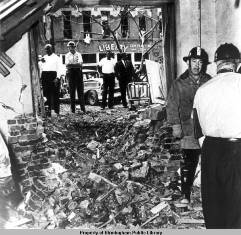
On September 15, 1963, an explosion shattered the quiet of a Sunday morning, blowing apart the 16th Street Baptist Church in Birmingham, Alabama. Four young girls who were getting ready for Sunday School were killed almost instantly.
 

Denise McNair, 11, Addie Mae Collins, 14, Carole Robertson, 14, and Cynthia Wesley, 14 died as a result of a bomb placed under the church by members of the Ku Klux Klan. Twenty-two others, including Collins' younger sister Sarah, were injured.
 
“I remember Denise asking Addie to tie her belt,” Sarah Collins Cox said in an interview. “And then it happened.”
 

Most Americans had little idea, or had paid little attention to the fact that Birmingham had been the scene of more than 50 bombings between 1947 and 1963. This bombing, however, would not go unnoticed. The murderous event awakened the nation and effectively galvanized the civil rights movement.
 

In the months leading up to the bombing, Birmingham had become the focal point of the civil rights front. The city was all too familiar with racial violence. Both African Americans and moderate whites had been long terrorized by the Klan.
Photograph of debris after bombing with firemen on site

 
Photograph of debris after bombingwith firemen on site. 1963. Alabama v.
Chambliss Trial Transcript (File # 85.1.22),
Birmingham Public Library Archives.
Property of Birmingham Public Library.
.


Years earlier, Birmingham minister Fred L. Shuttlesworth founded the Alabama Christian Movement for Human Rights (ACMHR) to directly confront racism and segregation in the city. In the spring of 1963, Shuttlesworth's group joined forces with Dr. Martin Luther King, Jr., and his Southern Christian Leadership Conference (SCLC), the largest and best known organization fighting for equal rights at the time. Together, the men formulated a plan that called for months-long protests to end segregation in Birmingham


In May of that year, after weeks of marches, sit-ins, boycotts, bus strikes, and prayer vigils, an agreement was reached. It had the input of local government leaders, white business owners, African American leaders and civil rights groups. The city would actively begin working toward integration. The agreement did not sit well with segregationists, among the most violent of which was the notorious KKK.

 
Riots erupted during the summer months, and nightly newscasts revealed to the rest of America the lengths to which Southern racists like Governor George Wallace and Birmingham's Commissioner of Public Safety Eugene “Bull” Conner would go in their fight to keep the South segregated.
 
Conner ran Birmingham's police and fire departments, and his ruthless tactics against the demonstrators shocked the country. With each evening's news, Americans watched as Conner's police used attack dogs, billy clubs, and tear gas on the peaceful protestors. He turned fire hoses on the crowd with water pressure so high it would “peel away skin,” according to press reports.


16th_Street_Baptist_Church_bombing_girls.jpg
The four girls killed during the
16th Street Baptist Church bombing.
Clockwise from top left: Addie Mae
Collins (aged 14), Cynthia Wesley
(aged 14), Carole Robertson
(aged 14) and Denise McNair (aged 11)
Still, it was the 16th Street Baptist Church and the deaths of four innocent children that finally snapped the nation and the federal government into action. All over the country, citizens became angry and ready for change. In June 1963, President John Kennedy introduced a civil rights bill, now known as the 1964 Civil Rights Act, to widespread support.
 
The 16th Street Baptist Church bombing is cited by many historians as the turning point in the civil rights movement. An editorial in the Milwaukee Sentinel said the bombing should “serve to goad the conscience” of the country. “The deaths...in a sense are on the hands of each of us.”
 
 
We should always keep in mind that the four girls who died, while immortalized in history, were children with children's dreams. Carol Robertson was a straight A student who loved to dance. Cynthia Wesley excelled in math. Addie Mae Collins was quiet, athletic, and had a flare for art. Denise McNair wrote plays for the kids in her neighborhood.
 

History is not scripted. In the case of the 16th Street Baptist Church bombing it was shaped out of racist hatred that ended four innocent lives, but changed America forever.
Lonnie Bunch, Director All the best,


Lonnie Bunch
Director