


|
Lonnie
Bunch, museum director, historian, lecturer, and author, is proud to present
A Page from Our
American Story, a regular on-line series for Museum
supporters. It will showcase individuals and events in the African American
experience, placing these stories in the context of a larger story — our
American story.
A
Page From Our American Story
“Pray, what thing in the world can be done worse towards us, than if men
should rob or steal us away, and sell us for slaves to strange countries;
separating housbands (sic) from their wives and children.” — from The Germantown
Protest (against slavery).
In 1565, the Spanish colony of St. Augustine, in what is now Florida, became
the first permanent European settlement in North America. Among the settlement's
population were some of the first enslaved Africans brought to the New
World.
The first permanent settlement of African slaves in British Colonial North
America arrived in Jamestown, Virginia, via a Dutch slave trading ship in 1619.
It wasn't long before the American colonies found themselves economically
dependent on slave trading and enslaved labor.
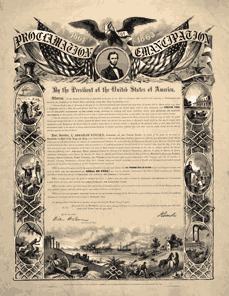
More than two hundred years later, on January 1, 1863, in the midst of our
civil war, Abraham Lincoln's Emancipation Proclamation would free slaves in the
rebellious southern states. The Proclamation, along with the voices and actions
of individuals such as Frederick Douglass, Sojourner Truth, Harriet Tubman,
William Lloyd Garrison, and others, would ultimately lead to the passage of the
13th Amendment two years later, ending slavery in the United States
and freeing nearly four million African Americans.
Before slavery truly became institutionalized in the colonies, some Africans
were sometimes treated more like indentured servants who were freed once their
service ended or debt had been paid, a practice employed at times by various
early Dutch and Spanish explorers and settlers. However, this changed
dramatically in 1641 when Massachusetts became the first British mainland colony
to legalize slavery. From that time forward, colonial slave laws became more
restrictive, further codifying the institution.
Not everyone was blind to slavery's immorality. Although slavery played a
major role in the economy of colonial Rhode Island, there were some who tried to
temper the practice with a 1652 law that placed restrictions on slave owning and
prohibited enslavement of any person for more than 10 years. However, the effect
was limited. Slave holders simply sold anyone nearing the deadline and took
ownership of new slaves, thus continuing the cycle.
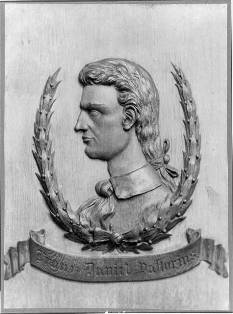
In 1688, Francis Daniel Pastorius, and three of his fellow Quakers, drafted
the first, formal anti-slavery resolution in America. The resolution raised
objections to slavery on both moral and practical grounds during a period when
Pennsylvania Quakers were nearly unanimous in their acceptance of the
practice.
The decree is referred to as “The Germantown Protest,” or “1688 Germantown
Quaker Petition Against Slavery.” It articulated themes of justice and equality
that would be echoed throughout the long, painful period of slavery in
America.
The authors’ premise was based on the biblical “Golden Rule” — treat others
as you wish to be treated. Additionally, the authors recognized that colonial
slave treatment mirrored the persecution Quakers had seen in Europe, and, to an
extent, in the colonies.
"There is a saying, that we should do to all men like as we will be done
ourselves; making no difference of what generation, descent, or colour (sic)
they are... To bring men hither [to America], or to rob and sell them against
their will, we stand against.”
Sadly, “The Germantown Protest” did not spark a significant change in the
Americas against slavery. Even within Quaker communities the declaration was
ignored, at least initially. But a seed had been planted. A belief shared
silently by many was given voice.
This year marks the 150th anniversary of the Emancipation
Proclamation. While it is tempting to view the Proclamation solely through the
lens of Civil War events, in order to grasp the full context and importance of
Lincoln’s decision, we must examine the issue of slavery in the North American
colonies from its beginnings. From the Spanish colony in St. Augustine, to the
first Dutch ship sailing into Jamestown, and to the Civil War waged to end it,
slavery was a 300-plus year institution in America, leaving scars, fortunes, and
repercussions we deal with still today.
| ||||
|
The
National Museum of African American History and Culture is the newest member of
the Smithsonian Institution's family of extraordinary
museums.
The
museum will be far more than a collection of objects. The Museum will be a
powerful, positive force in the national discussion about race and the important
role African Americans have played in the American story — a museum that will
make all Americans proud.
|



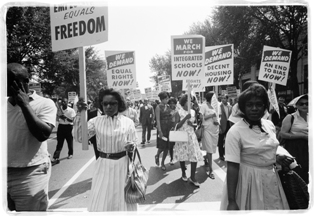 March on Washington
participants. Aug. 28, 1963.
March on Washington
participants. Aug. 28, 1963.