Newsletter from the National Black MBA Association:
| ||
|


| ||
|
Missing: Leadership and Core
Values
|
 “It will not be
sufficient for Morehouse College, for any college, for that matter, to produce
clever graduates, men fluent in speech and able to argue their way through; but
rather honest men, men who can be trusted in public and private—who are
sensitive to the wrongs, the sufferings, and the injustices of society and who
are willing to accept responsibility for correcting the ills.” --Dr. Benjamin E. Mays President, Morehouse College
"Dr. Benjamin E. Mays, Morehouse College’s president
from 1940-1967, said this about the kind of men and leaders he expected
Morehouse to produce. As a student at neighboring Spelman College, I heard and
saw Dr. Mays often and had the privilege of singing in Morehouse’s Sunday
morning chapel choir and hearing this great man’s wisdom. Of the six college
presidents in the Atlanta University academic complex Dr. Mays was the one
students looked up to most. He inspired and taught us by example and stood by us
when we challenged Atlanta’s Jim Crow laws in the sit-in movement to open up
public accommodations to all citizens. Dr. Mays taught us that “not failure, but
low aim is sin” and warned that “the tragedy of life is often not in our
failure, but rather in our complacency; not in our doing too much, but rather in
our doing too little; not in our living above our ability, but rather in our
living below our capacities.” As students we hungrily internalized his unerring
belief that we were God's instruments for helping transform the world, and like
many others who heard him frequently, I often repeated his words. One of the
many Morehouse students Dr. Mays helped shape was Dr. Martin Luther King, Jr.
whom he lovingly eulogized on that campus after his 1968 assassination.
Who are our Dr. Mayses today – our moral compasses
in crucial sectors of American life? What a contrast Dr. Mays’ example is to
that of a college president in the headlines recently, Dr. James Wagner of Emory
University, who was criticized for praising the 1787 compromise declaring that
every slave would be counted as three-fifths of a person for purposes of state
representation in Congress as an example of “noble achievement” that allowed
Northern and Southern White congressmen to “continue working toward the highest
aspiration they both shared—the aspiration to form a more perfect union.”
We have struggled for over two centuries to overcome
the crippling birth defects and glaring hypocrisies between the eloquent words
that “all men are created equal with certain inalienable rights” in our
Declaration of Independence belied by slavery, Native American genocide, and
exclusion of women and non-propertied White men in our founders’ deeds. That
tragic hypocrisy resulted in a bloody Civil War that took more than 530,000
American lives and a post-Reconstruction era with Jim Crow laws, decades of
struggle, and many lost lives, countless marches, lawsuits, and legislative
efforts to achieve major civil rights legislation. And we must still be vigilant
and fight to protect the hard earned social and racial progress over the last
half century from being undermined by voter suppression, the Cradle to Prison
Pipeline, mass incarceration, and pervasive economic and educational
inequalities. What kind of message did Dr. Wagner’s words send to Emory’s Black
students, who were quickly joined by some White students, faculty members, and
others in denouncing his endorsement of the decision that codified
less-than-fully-human status as “5/5ths outrageous”?
And what message did it send to students and
citizens of every color when Dr. Mary Jane Saunders, the president of Florida
Atlantic University, sold the naming rights to its stadium for six million
dollars to the private prison company GEO Group? At a protest rally on campus,
an attorney for the American Civil Liberties Union cited GEO Group’s
“well-publicized record of abuse and neglect,” and quoted from an order of U.S.
Judge Carlton Reeves describing one of their correctional facilities for minors
and older teenage prisoners in Mississippi as “a cesspool of unconstitutional
and inhuman acts and conditions” and “a picture of such horror as should be
unrealized anywhere in the civilized world.”
I do not believe this is the ideal of universities
producing leaders “who are sensitive to the wrongs, the sufferings, and the
injustices of society and who are willing to accept responsibility for
correcting the ills” that Dr. Mays sought and taught. Who are the successor
leaders today to Dr. Mays? Where are today’s moral leaders in other critical
sectors who challenge and set the example for the rest of us? Where are today’s
Abraham Joshua Heschels or Reinhold Niebuhrs or Eleanor Roosevelts or Dorothy
Days? Where are Senators like Phil Hart and Wayne Morse who helped set a tone of
political discourse too missing today in our legislative bodies? Where will the
next leaders we can look up to as courageous and sacrificial champions of
justice like Dr. King, Reverend Fred Shuttlesworth, Medgar Evers, Andrew
Goodman, Mickey Schwerner, and James Chaney come from?
At the same time that we have a crisis in visible
servant leadership examples we have a crisis in core values. Are we content to
be a society where virtually anything is available for profit or for sale,
including the sale over the counter at Wal-Mart and other stores of deadly
assault weapons capable of gruesome and senseless mass destruction like that
which ravaged twenty small Newtown children and their teachers? Are we content
to have deadly assault weapons treated as normal consumer products like toasters
or vacuum cleaners? How have we come to normalize violence and unbridled
commercialization unmoored from common and moral sense and public safety.
Is this the best we have to pass on to our children
and grandchildren and the next generation of leaders the nation and world need
today and tomorrow? Do corporate profits from dangerous products or harmful
practices trump children’s security and safety in our nation? Is compromise that
allows gross or some significant human injustice the best we can expect
from American democracy? Isn’t it time to engage in a fuller discussion about
the breakdown of core values in America and the values we do agree on
and need and want to instill in the next generation? What does it mean to be an
American? What does it mean to be a human being? Robert Kennedy said this to
students at the University of Kansas in 1968 about the need to rethink how we
measure success in America:
“Too much and too long, we seem to have surrendered
community excellence and community values in the mere accumulation of material
things. Our gross national product ... if we should judge America by that—counts
air pollution and cigarette advertising, and ambulances to clear our highways of
carnage. It counts special locks for our doors and the jails for those who break
them. It counts the destruction of our redwoods and the loss of our natural
wonder in chaotic sprawl. It counts napalm and the cost of a nuclear warhead,
and armored cars for police who fight riots in our streets. It counts Whitman’s
rifle and Speck’s knife, and the television programs which glorify violence in
order to sell toys to our children.”
Senator Kennedy continued: “Yet the gross national
product does not allow for the health of our children, the quality of their
education, or the joy of their play. It does not include the beauty of our
poetry or the strength of our marriages; the intelligence of our public debate
or the integrity of our public officials. It measures neither our wit nor our
courage; neither our wisdom nor our learning; neither our compassion nor our
devotion to our country; it measures everything, in short, except that which
makes life worthwhile. And it tells us everything about America except why we
are proud that we are Americans.”
I hope and pray we will not raise a new generation
of children with high intellectual quotients and low caring and compassion
quotients; with sharp competitive edges but dull cooperative instincts; with
highly developed computer skills but poorly developed consciences; with a
gigantic commitment to the big “I” but little sense of responsibility to the
bigger “we”; with mounds of disconnected information without a moral context to
determine its worth; with more and more knowledge and less and less imagination
and appreciation for the magic of life that cannot be quantified or
computerized; and with more and more worldliness and less and less wonder and
awe for the sacred and everyday miracles of life. I hope as parents, educators,
and faith, community, public and private sector leaders that we will raise
children who care and work for justice and freedom for all."
SUPPORT CHILDREN'S DEFENSE FUND |
 "Dr. Martin Luther King, Jr. wrote these words in his
April 1963 Letter from a Birmingham Jail, in the same passage with his
well-known warning that “Injustice anywhere is a threat to justice everywhere.”
A few months later, Dr. King wrote that the same culture of violence that killed
Medgar Evers in Mississippi in June 1963 and four little Black girls in
Birmingham in September 1963 had finally killed President Kennedy in November
1963 reminding us that it’s not possible to confine injustice, hatred, or
violence to one group or community. What is tolerated in one place will
eventually infect and affect everyone.

| Changing America: The Emancipation Proclamation,
1863 and the March on Washington, 1963
Opens
December 14, 2012
NMAAHC Gallery at American History, second floor east
On August 28, 1963, at the March on Washington,
Martin Luther King Jr. began his speech by declaring, "Five score years ago, a
great American, in whose symbolic shadow we stand, signed the Emancipation
Proclamation. This momentous decree came as a great beacon light of hope to
millions of Negro slaves who had been seared in the flames of withering
injustice. It came as a joyous daybreak to end the long night of captivity ...
In a sense we have come to our nation's capital to cash a check."
In 2013 the country will commemorate two events that
changed the course of the nation — the 1863 Emancipation Proclamation and the
1963 March on Washington. Standing as milestone moments in the grand sweep of
American history, these achievements were the culmination of decades of
struggles by individuals — both famous and unknown — who believed in the
American promise that this nation was dedicated to the proposition that "all men
are created equal." Separated by 100 years, they are linked together in a larger
story of freedom and the American experience.
To commemorate these two pivotal achievements, the
Smithsonian’s National Museum of African American History and Culture (NMAAHC)
in collaboration with the National Museum of American History (NMAH) will
present an exhibition, featuring historic photographs, paintings, new film
footage and objects, that explores the historical context of these two crucial
events, their accomplishments and limitations, and their impact on the
generations that followed.
The exhibition
will be on view from Dec. 14, 2012 through Sept. 15, 2013 in NMAAHC’s temporary
gallery on level two at American History, 14th St NW and Constitution
Ave NW. Metro: Smithsonian or Federal Triangle.
For more information, visit www.nmaahc.si.edu.
|
This is a newsletter that was emailed today from the National Museum of African American History and Culture:
Lonnie
Bunch, museum director, historian, lecturer, and author, is proud to present
A Page from Our American Story, a
regular on-line series for Museum supporters. It will showcase individuals and
events in the African American experience, placing these stories in the context
of a larger story — our American story.
A
Page From Our American Story
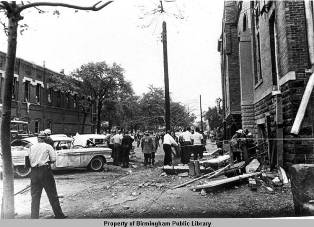
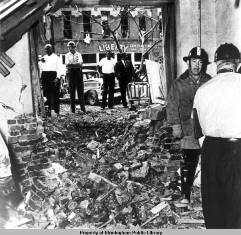
On September 15, 1963, an explosion shattered the quiet of a Sunday morning,
blowing apart the 16th Street Baptist Church in Birmingham, Alabama.
Four young girls who were getting ready for Sunday School were killed almost
instantly.
Denise McNair, 11, Addie Mae Collins, 14, Carole Robertson, 14, and Cynthia
Wesley, 14 died as a result of a bomb placed under the church by members of the
Ku Klux Klan. Twenty-two others, including Collins' younger sister Sarah, were
injured.
“I remember Denise asking Addie to tie her belt,” Sarah Collins Cox said in
an interview. “And then it happened.”
Most Americans had little idea, or had paid little attention to the fact that
Birmingham had been the scene of more than 50 bombings between 1947 and 1963.
This bombing, however, would not go unnoticed. The murderous event
awakened the nation and effectively galvanized the civil rights
movement.
In the months leading up to the bombing, Birmingham had become the focal
point of the civil rights front. The city was all too familiar with racial
violence. Both African Americans and moderate whites had been long terrorized by
the Klan.
.
Years earlier, Birmingham minister Fred L. Shuttlesworth founded the Alabama Christian Movement for Human Rights (ACMHR) to directly confront racism and segregation in the city. In the spring of 1963, Shuttlesworth's group joined forces with Dr. Martin Luther King, Jr., and his Southern Christian Leadership Conference (SCLC), the largest and best known organization fighting for equal rights at the time. Together, the men formulated a plan that called for months-long protests to end segregation in Birmingham
In May of that year, after weeks of marches, sit-ins, boycotts, bus strikes,
and prayer vigils, an agreement was reached. It had the input of local
government leaders, white business owners, African American leaders and civil
rights groups. The city would actively begin working toward integration. The
agreement did not sit well with segregationists, among the most violent of which
was the notorious KKK.
Riots erupted during the summer months, and nightly newscasts revealed to the
rest of America the lengths to which Southern racists like Governor George
Wallace and Birmingham's Commissioner of Public Safety Eugene “Bull” Conner
would go in their fight to keep the South segregated.
Conner ran Birmingham's police and fire departments, and his ruthless tactics
against the demonstrators shocked the country. With each evening's news,
Americans watched as Conner's police used attack dogs, billy clubs, and tear gas
on the peaceful protestors. He turned fire hoses on the crowd with water
pressure so high it would “peel away skin,” according to press
reports.
Still, it was the 16th Street Baptist Church and the deaths of
four innocent children that finally snapped the nation and the federal
government into action. All over the country, citizens became angry and ready
for change. In June 1963, President John Kennedy introduced a civil rights bill,
now known as the 1964 Civil Rights Act, to widespread support.
The 16th Street Baptist Church bombing is cited by many historians
as the turning point in the civil rights movement. An editorial in the Milwaukee
Sentinel said the bombing should “serve to goad the conscience” of the country.
“The deaths...in a sense are on the hands of each of us.”
We should always keep in mind that the four girls who died, while
immortalized in history, were children with children's dreams. Carol Robertson
was a straight A student who loved to dance. Cynthia Wesley excelled in math.
Addie Mae Collins was quiet, athletic, and had a flare for art. Denise McNair
wrote plays for the kids in her neighborhood.
History is not scripted. In the case of the 16th Street Baptist
Church bombing it was shaped out of racist hatred that ended four innocent
lives, but changed America forever.
|


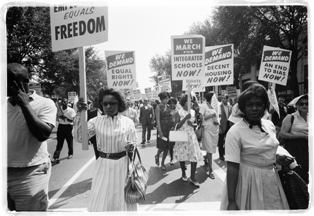 March on Washington
participants. Aug. 28, 1963.