
Welcome! This free speech community journal was created so the Maple Heights African American community could share videos, photos, events, articles, posts, ideas, thoughts, and information. We're now exclusively on Facebook, so don't forget to also check out our Facebook page. Have a fantastic day!

Showing posts with label LABOR. Show all posts
Showing posts with label LABOR. Show all posts
Thursday, July 24, 2014

Monday, July 21, 2014
Saturday, December 14, 2013
PROBLEMS WITH OUTSOURCING AND PUBLIC MERGERS
Cities have turned to outsourcing and mergers as a panacea to financial budget constraints [a result of, to some degree, poor government policies and a lack of intelligent, creative urban planning]. Unfortunately, this has led to other problems; specifically, higher unemployment rates among the poor and "people of color".
It's bad enough (even insulting at times) that predominantly African American communities are under-represented in the workforce (public and private), but increasingly devastating are the ongoing threats ... "outsourcing" and "public mergers".
Aside from the issue of a lack of minority contractors, does outsourcing release a city from regulations and laws designed to protect certain groups from being discriminated against in hiring?
Are these private companies [that we've outsourced to] scrutinized for their hiring practices? It shouldn't matter if you are public or private, if you are receiving tax payer dollars, public monies, you should be bound by the same state affirmative action programs, anti-discrimination laws, EEOC regulations, etc. [A word to the wise ... those cities who band together to use the same private company, ... you better make damn sure those regulations and laws are being complied with.]
African Americans need to take a look at the companies their city contracts with.
African Americans (esp. in predominantly Black neighborhoods) also need to take a close look at: who is delivering their mail and packages; who is reading their gas and electric meters; who the cable guy is; who represents them; who teaches their children; ... Where I live, I see a lot of white males in these roles (with the exception of teachers who are mostly white females).
What is most alarming is that more and more Blacks (esp. Black males) are disappearing from the [full-time] workforce. While this is alarming, it is not surprising. The "system" has created problems (social, financial, political, legal, structural) that is unique, offensive, and devastating to African Americans and other "people of color". In the mix [laws that give certain groups (dominated by whites) an advantage, our unjust legal/justice system, overcriminalization, the for-profit prison system, and law enforcement (which is predominantly white and designed to act in one's own best interests) which has the power to completely destroy an individuals life], and you get some understanding why Blacks and other "people of color" have higher unemployment rates than other racial/ethnic groups.
It's high time we address these issues, and also come up with intelligent and creative ways to insure that "people of color" are properly represented in every industry in the workforce.
RELATED:
Top 6 Outsourcing Disadvantages: Outsourcing Disadvantages: Reasons That Outsourcing is Bad for Your Company By James Bucki
How Employers Weed Out Unemployed Job Applicants .. 1/14/2011
Employment Law Outsourcing Checklist (Mar 2006)
What is White Supremacy?
Monday, April 29, 2013
Thursday, March 28, 2013
FAIR MINIMUM WAGE ACT

| Calling for Passage of a Fair Minimum Wage Act in Cleveland | |||
At Brothers Printing in Cleveland this
week, U.S. Senator Sherrod Brown called for passage of the Fair Minimum Wage Act, legislation that would raise the federal minimum wage to $10.10 an
hour in three steps and provide the first minimum wage increase to tipped
employees in more than 20 years.
“Northeast Ohio citizens work hard, play by the rules, and should be able to take care of their families. But too many Ohioans are working harder than ever – and barely getting by,” said Sen. Brown. “Working full-time in a minimum wage job in Ohio pays about $16,000 per year – which isn’t much to live on when you’re trying to put food on the table, fill your gas tank, send your children to school, and provide a safe place for them to live. Ensuring a fair wage is good for middle class families and good for our economy.” Sen. Brown was joined by Brothers Printing owners Joe and Jay Kaufman, of Cleveland, and Synergistic Systems owner Carlynn Canny, of Willoughby Hills, who explained their reasons for supporting an increase in the Federal minimum wage and called on their competitors to do the same. 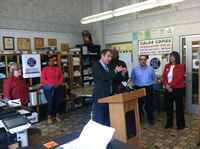
“I
strongly support raising the minimum wage as proposed,” said Canny. “As a
business owner, the value of my company is the work force. Having a strong
minimum wage helps everyone, as workers feel better about the company and about
their jobs and spend more and contribute to a robust economy. Every person who
works hard should earn at least a living wage. In the end, it also costs all of
us less, and it is the right thing to do.”
Also joining Sen. Brown was Chris Barksdale, a former social worker, who told his story and recalled the stories of countless others who struggled to survive and support their families on the minimum wage. “Conscientious people know it is impossible to live on less than $10 an hour in today’s society,” Barksdale said. Sen. Brown is the cosponsor of the Fair Minimum Wage Act of 2013, legislation that would raise the federal minimum wage. The bill would:
Workers who are paid a minimum wage in Ohio earn only $16,000 per
year, which is more than $3,000 below the poverty level for a family of three.
The Fair Minimum Wage Act would boost the minimum wage to $21,000,
lifting families above the poverty line. According to the National Employment
Law Project, the minimum wage has lost more than 30 percent over the last forty
years. If the minimum wage had kept up with inflation, it would be worth
approximately $10.55 per hour today. Increasing the minimum wage would boost GDP
by nearly $33 billion and generate 140,000 new jobs over the course of three
years as workers spend their raises in their local businesses and communities.
|


Subscribe to:
Posts (Atom)